DES302 Blog 1:

Welcome to my semester two project blogs! Here I will be publishing weekly recaps of project progress as documentation and personal check-ins.
For my first blog I will be following the structure of Gibbs' Reflective Cycle (University of Edinburgh. 2020) as I believe it has a great expansive structure to cover all the essential details of a reflection.

The University of Edinburgh. (2020, November 11).
The Gibbs' Reflective Model is divided into 6 steps: Description, Feelings, Evaluation, Analysis, Conclusion, and Action Plan.
These steps cover pretty much all you need for a successful reflection; where you revise what happened, analyse the situation and think critically on what you would change/do for the future.
One potential drawback however, is that this cycle is can be interpreted as mainly focusing on the writer's emotions and thoughts over what work happened, so I will keep this in mind when balancing describing thoughts and progress.
With that out the way, let's begin!
Description: What has happened across weeks 1 and 2?
Across the first two weeks of our final semester, we have been introduced to our complementary classes 301 and 302, which work in tandem for us to produce and document our final projects, and started working on refined concept ideas to back our chosen problem areas.
Thankfully I already had a pretty strong idea of what I wanted to create from the end of semester one: With my how-might-we statement being "how might we improve the wellbeing of students suffering burnout by using emerging technologies?" I have chosen to create a RPG adventure app that converts real life tasks & steps into energy to fuel storylines and quests at the end of each day.
Players would join with a party of friends to explore and influence the world, and can remind each other to stay on top of tasks to complete their daily adventures. The main idea is that the app will encourage those in burnout spirals to work on a healthier more balanced & social lifestyle to relieve stress and burnout symptoms.
So far I just have that main idea in mind, I need to work out more specifics and research reasoning to properly refine the concept. From there I have a lot of work cut out for me in worldbuilding, concept art, and working on making a viable prototype to showcase within 12 weeks.
I also have created my Miro board, and laid down a base timeline following the main stages of my chosen methodology the Double Diamond:

Design Council. (2023).
I chose this methodology as while simple in structure, it's a great way to mark major project stages and open to repeat stages for further refinement.

My Miro board (29/7/24).
So far I have structured my Miro board with a main timeline following Double Diamond checkpoints, included prior DES300 research, and laid down three plans to follow. My goal for a realistic plan in creating an app concept, is to have a prototype on Figma that is able to be navigated, includes art, animation, and even sound.
Following the discovery phase of Double Diamond, I have also looked at apps and games that follow similar ideas to my concept to get an idea of where they could improve, and potential gaps in the market.
Feeling: How do I feel about the achieved work?
Overall I don't feel like I have achieved as much as I could have or should be - regarding the amount of work I am setting up for myself. Although I want to jump straight into concept art and worldbuilding, I am aware of other tasks such as ethic modules, the report, and presentations we need to set up to present our refined concepts in week 4. It feels like that once those tasks are out of the way my work direction will be more flexible to achieve my prototype.
Evaluation: The good and the bad?
While I don't feel on track for initial assignments, there is still room to complete those comfortably and set myself up for future work.
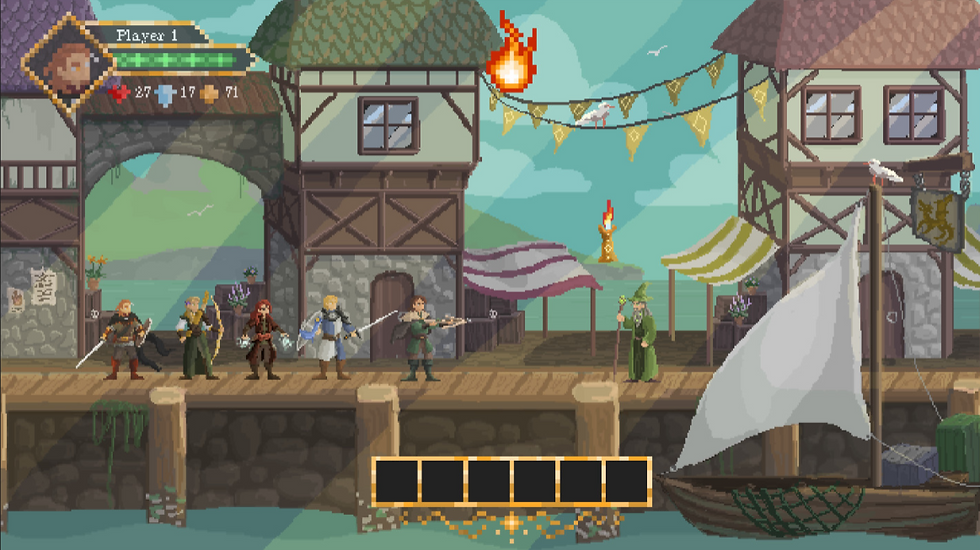
A positive side is that I have started to gather inspiration on Pinterest for game elements such as style, mechanics and animation, and feel greatly inspired to push forwards with my project in a refined pixel style.

My Pinterest board (29/7/24).
We have also formed loosed groups in DES301 so I know a few other students also looking to make game concepts, which is great because we can help each other stay on track!
Analysis and Conclusion: Making sense of progress
So overall in the first two weeks I have:
Set up my Miro board
Laid down a timeline, methodology and deadlines
Created three plans: (A as a perfect plan, B as realistic, and C as bare requirements covered)
Looked at inspiration of similar apps and games
Thought more on the aesthetics and base system of my RPG app
Gathered some visual inspiration
Progress is progress, and I have moved forwards somewhat in gaining a stronger idea for the app. I'm feeling a bit less directionless now as to what I felt entering week one.
Action Plan: Moving forward
Looking towards week 3, I need to focus my attention to refining the reasoning behind my research and how my app is going to work in order to set up a presentation for week 4. I also need to remember to keep on top of my 302 project report, which I haven't done too much for yet as there's not much project progress to document.
In order to stay on track I have to keep on top of work this semester. Naturally I am a procrastinator, but cannot afford to speed through any stage of work for this final project, due to workload and the fact that I want to put as much work into making this prototype as possible. To help mitigate this I will start keeping more detailed time records of work sessions on my Miro timeline to keep track of progress, and get used to proper task scheduling - I'm going to need it!
References:
Design Council. (2023). Framework for innovation. Design Council.
The University of Edinburgh. (2020, November 11). Gibbs’ Reflective Cycle. The University
of Edinburgh; The University of Edinburgh.


Comments